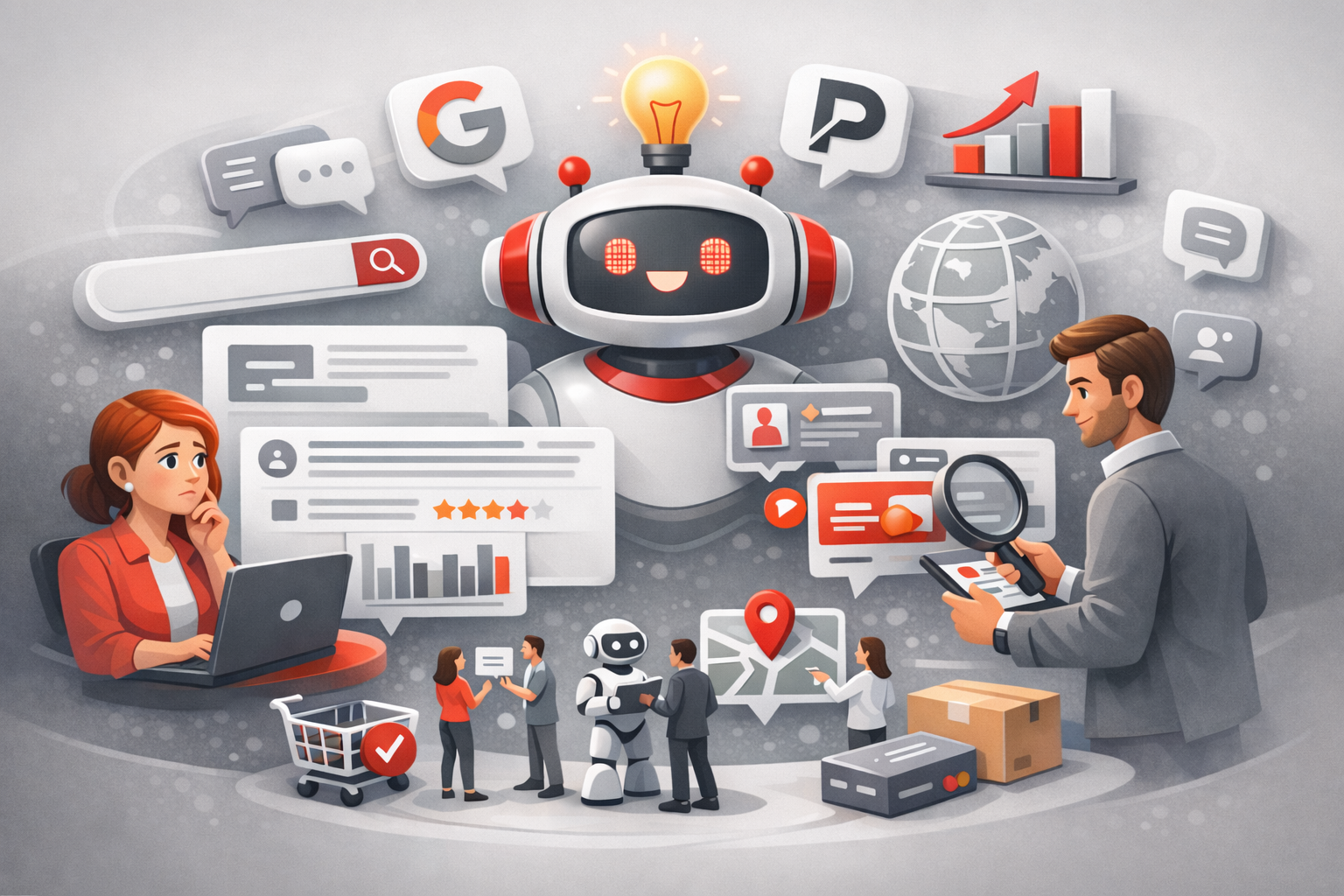
AI is changing the way people search, and it’s affecting many business owners by quietly reshaping how customers find products and services.
AI search tools (such as ChatGPT, Google AI Overviews, and Perplexity) are able to generate summarized answers in response to a user’s question, rather than returning a list of links users’ needs to click through. When a customer types a question into one of these tools, they often get an answer without ever visiting a website, clicking an ad, or seeing where a website ranks on Google.
This new style of search is changing how customers discover businesses, compare options, and make buying decisions.
How Big Is AI Search?
AI-powered search tools accounted for roughly 5–6% of global search market share in the beginning of 2025. By the end of the year, that figure was 12–15%, according to Pushleads.
ChatGPT handles over a billion queries each day, and grew from 400 million to 800 million weekly active users between February and October 2025. Perplexity reported 780 million monthly queries by May 2025, a 239% increase from August of 2024.
Google expanded AI Overviews (which provides AI-generated summaries that appear at the top of Google search results) to more than 200 countries and 40 languages, with 2 billion monthly users now engaging with them globally, per Google’s blog. As of December 2025, Google still held approximately 90.82% of the overall search market, but the landscape has expanded, according to Statista. ChatGPT, which held 69.1% of market share in January 2025, had fallen to 45.3% in January 2026 among daily U.S. users of the mobile app. Gemini, Google’s AI, has risen from 14.7% to 25.1% in the same period. There is more than one place where customers look for answers, and each new search query option plays by different rules.
An estimated $750 billion in U.S. revenue is projected to be impacted through AI-powered search by 2028, according to McKinsey research. About half of all Google searches already include AI-generated summaries, according to McKinsey’s surveys. The figure is expected to exceed 75 percent by 2028. In a survey from August 2025, 40–55% of consumers in top sectors (including grocery, travel, wellness, apparel, and financial services) are using AI-based search for purchasing decisions. A survey from GWI found that 31% of Gen Z users prefer AI search options to traditional search engines. As the nature of search continues to shift, marketing strategies will evolve alongside it as businesses find new ways to reach out to customers.
How AI Search Is Already Affecting Businesses
As AI search continues to surge in use and popularity, business owners will experience greater impacts on how customers behave and interact with their businesses.
Fewer Customers Are Clicking Through to Websites
Zero-click searches (searches where users get their answer directly from an AI tool or results page, without ever clicking through to a website) are rising across all search categories. Customers are getting answers without visiting any websites, resulting in declining search referral traffic. Businesses whose marketing has relied heavily on organic search are exposed to significant drops in customer traffic.
According to HubSpot, AI Overviews now dominate screens, taking up 42% of desktop screens and 48% of mobile screens, pushing organic results further down and making them more difficult to find. Ranking well no longer guarantees that a website will be seen for a search query.
McKinsey research projects that brands unprepared for the AI search shift may experience a 20–50% decline in traffic from traditional search channels. If your business generates 500 qualified leads a year from organic search, a decline in that range means losing 100 to 250 of those leads, without changing a single thing about your offer.
Where Search Starts Is Changing
A study by Eight Oh Two found that 37% of buyers now begin searches with an AI tool over a traditional search engine. The reasons cited for this shift away from traditional search are primarily practical: 40% of respondents claimed too many links to click through, 37% cited too many ads, 33% said it was difficult to receive a straight answer, and 28% reported low-quality results. A HubSpot study reported that 79% of respondents who already use AI for search say the experience is better than using search engines.
Most users are still using both AI search and search engines, according to NN Group. AI search or an AI overview answer is just the first answer; many customers then use traditional search to confirm the response and find more information.
What Has Changed About How Customers Search
The way customers search is changing: rather than relying on a single search engine, they’re sourcing information from multiple sources, using ChatGPT, Perplexity, Google, TikTok, or YouTube.
AI Platforms Cite Sources; They Don’t Rank Them
Traditional search engine optimization (SEO) is built around ranking. AI tools are different: they generate a single summarized answer and reference the sources they drew from. The practice of optimizing your content so that AI tools cite and reference your website in answers is called generative engine optimization (GEO). In traditional search, there are ten results on the first page. When using AI search, there may only be one answer, and your business website either contributed to it, or it didnt.
Intent Drives Discovery More Than Keyword Volume
Customers are using longer, more conversational queries, describing a problem they need solved rather than using a short keyword phrase. Successful content genuinely helps users find useful answers rather than includes the right words at the right frequency, which used to be a tactic that would help content appear on the first page of search results.
The Content Sameness Problem
As AI tools make it easier to create large volumes of content with little time or effort, generic content is flooding the web. Much of this quickly generated copy is indistinguishable from other similar pages, which means taking time to create quality content pays off. AI search tools and systems are designed to show content that demonstrates first-hand knowledge and expertise, prioritizing information that answers queries with useful information. For business owners who know their industry deeply and thoroughly, this can be a serious competitive advantage and an opportunity to give their websites an edge. Creating useful content that answers questions knowledgably and with expertise can give businesses an edge in how they appear in AI search queries.
The Bottom Line
AI search is changing the way businesses approach marketing strategies. Businesses likely to see success won’t necessarily be the largest or more technically sophisticated, but may be those with credible content, clear positioning, and strategy that accounts for where buyers are looking for information. Navigating that kind of shift is exactly what a Fractional CMO is built for: senior-level marketing leadership that helps business owners adapt to changes like this without becoming AI experts themselves.
Ready to explore how fractional CMO leadership could transform your marketing results? The future of marketing leadership is flexible, strategic, and results-focused. And it’s available to your business today.
Frequently Asked Questions
What is AI search and how is it different from traditional Google search?
Traditional Google search returns a list of links in response to a query, leaving the user to click through and find the answer themselves. AI search tools such as ChatGPT, Google AI Overviews, and Perplexity generate a single summarized answer directly, drawing from multiple sources without requiring the user to click anywhere.
Is AI search affecting businesses outside of technology and marketing?
AI search is affecting customer behavior across virtually every industry: professional services, retail, financial services, healthcare, home improvement, and more. If customers use the internet to research a problem, compare options, or find a provider, they are likely already using AI tools as part of that process.
What is GEO, how is it different from SEO, and do I need both?
Generative engine optimization (GEO) is the practice of optimizing content so that AI tools cite and reference a website or business in their answers. Traditional SEO focuses on improving positions in ranked search results; GEO focuses on making content credible, well-structured, and authoritative enough that AI tools draw from it when generating answers.
How do I find out if my business is being cited by AI tools?
The simplest starting point is a manual AI presence audit. Open ChatGPT, Perplexity, and Google, and search for the problem your business solves (not your business name). Ask questions the way your customers would: “What should I look for in a ?” or “How do I solve ?” Note which businesses are cited, what answers customers are receiving, and where (if anywhere) your business appears.
What kind of content performs best in AI search results?
AI tools prioritize content that demonstrates genuine expertise, answers questions directly and completely, and is structured in a way that’s easy to parse. Content that performs well tends to be specific rather than general, experience-driven rather than generic, and organized with clear headings and direct answers. Question-based content (content that mirrors the conversational questions customers actually ask) tends to be particularly effective. A smaller number of deeply useful, well-structured pieces will generally outperform a larger volume of surface-level content optimized primarily for keyword volume.
Does AI search replace Google, or do I need to be visible in both places?
Google still holds approximately 90.82% of the overall search market, and AI Overviews are now part of what Google shows users in search results. At the same time, a meaningful and growing share of customers are beginning their research in standalone AI tools like ChatGPT and Perplexity. Research shows that most customers still use both: AI delivers the first answer, and traditional search is often used to confirm it. The goal is to be credible and present in both environments, not to choose between them.